Dark Math · Release 003
The Lunar 'Obelisks' Are Boulders.
Seven objects in a 1966 lunar orbiter photo threw long, spindly shadows and got compared to Egyptian obelisks — one famous estimate put them at 213 metres tall. The estimate skipped one step: dividing by the tangent of the Sun's angle. Do the trigonometry and the towers shrink to boulders under a grazing sun. Their curious arrangement? That part we happily leave on the table.
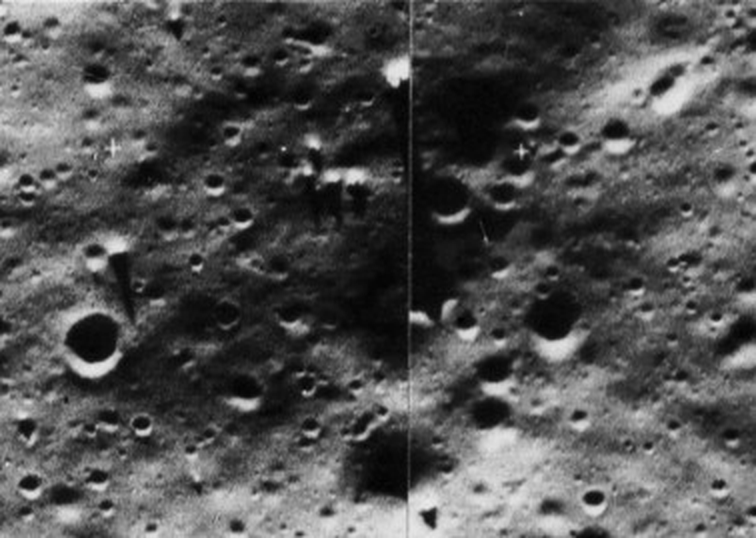
In 1966 an orbiter photographed seven objects in the Sea of Tranquillity throwing long, spindly shadows. Someone compared them to Egyptian obelisks; a book quoted one at 213 metres tall. This is a cleaner case than a “face,” because the whole claim is shadow length → height — and that’s arithmetic. We did the arithmetic. And then, honestly, we found the one part it doesn’t settle.
Where we land: resolved — the “obelisks” are boulders under a grazing Sun. One part stays honestly open: their arrangement. The good kind of open.
A shadow’s length is not a height. It’s a height times a number that depends on the Sun. When the Sun is high, shadows are stubs; when it grazes the horizon, a pebble throws a shadow like a flagpole. Here the Sun sits at 10.9° — about as low as it gets. At that angle the shadow of anything is 1 / tan(10.9°) = 5.2× its height. So the arithmetic runs the other way: divide the shadow by 5.2 to get the object.
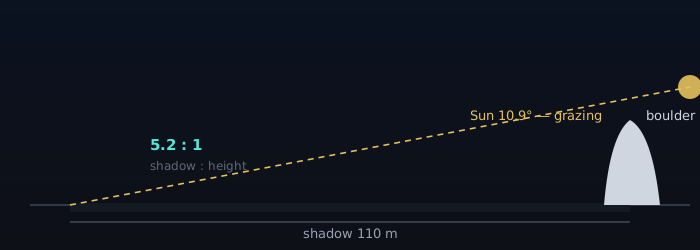
Cuspid 5, the biggest, casts a 110 m shadow. Divide by 5.2 and it stands ~21 m tall — a large boulder, roughly a six-storey rock. And the famous “213 metres” from a popular book? Run it forward: a 213 m spire at this Sun angle would throw an 1,106 m shadow — ten times what’s in the photograph. The figure simply forgot the tangent. There are no towering obelisks here; there are boulders, and a Sun so low it stretches their shadows into spires.
What the math proves
The objects are boulder-scale — the tallest ~21 m. The long shadows are the 10.9° Sun, not anomalous height. The “213 m obelisk” is a 10× arithmetic error. And their recoverable shapes are wide and rounded — rocks, not spires.
What honestly stays open
The arrangement. Cuspids 4 and 6 really do sit at the base of neat isosceles triangles with the others. A genuine geometric coincidence, or attention finding order in scatter? The pattern isn’t repeated elsewhere on the Moon — which argues chance — but a single low-res 1966 frame can’t settle a pattern claim. So we mark it the way we’d want anyone to: probably coincidence — not proven. Still an open case, and the good kind.
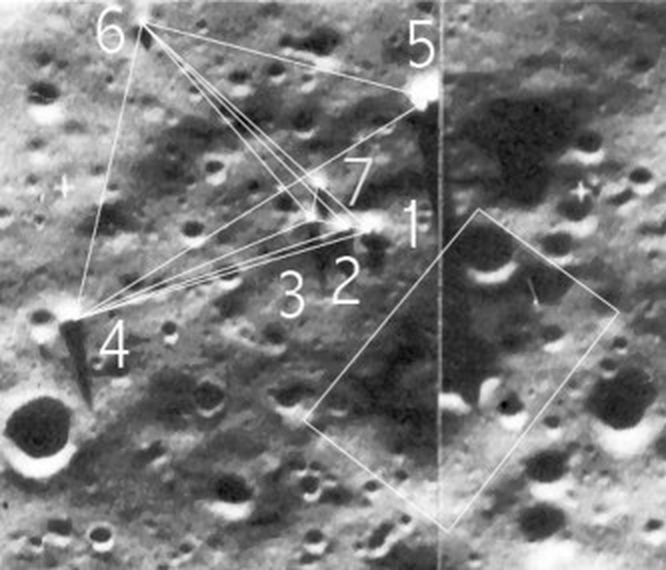
Dividing a shadow by a tangent is proof. Reading triangles in seven dots is a coin-flip you don’t get to call from one photograph. An honest method says both out loud.
Where this lands
Proven: no obelisks. The cuspids are boulders up to ~21 m; their spire-like shadows are a low Sun doing what a low Sun does; and the headline “213 m” is an order-of-magnitude arithmetic slip. Unresolved: whether their layout is a real pattern or the eye finding order in scatter — most likely coincidence, but not something a single 1966 frame can decide. This is the case working exactly as it should: the math settles the big claim, and refuses to over-claim the small one.
Why our math sees more — both ways
Surface-first analysis looks at spiky shadows and feels a monument. Structure-first analysis asks what geometry those shadows require — and geometry answers flatly: 21 m rocks under a 10.9° Sun. But the same discipline that settles the height is what forbids us from settling the arrangement, because a subjective pattern in seven points has no clean measurement from one frame. Dark Math isn’t a debunking machine. It proves what’s provable and it marks the doubt where the doubt is real — which is the only way a method earns trust the next time it says “settled.”
Sources
image / analysis — Lunar Orbiter II frame LO2-61H3 (NASA, 2 Nov 1966), Sea of Tranquillity ~15.5°E 5.1°N · shadow-geometry after K. Matthews, “The Blair Cuspids.”
the numbers — Sun elevation 10.9° · Cuspid 5 shadow ≈ 110 m → height ≈ 21.2 m (flat-ground assumption) · popular “213 m” = a dropped tangent.
background — “Blair Cuspids” (Lunascan Project) · “Transient / anomaly” lunar literature.