Dark Math · Release 011
The Curve That Won't Fall.
Weigh a galaxy by its light and Newton says the outer stars should slow down. They don't — the rotation curve goes flat, in galaxy after galaxy. The flat curve is settled fact; the reason is one of the great open questions. Dark matter explains the big-scale universe beautifully but its particle keeps not showing up; modified gravity fits galaxy curves suspiciously well but struggles at larger scales. On this data, honestly, you can't tell them apart — which is exactly what makes it delicious.
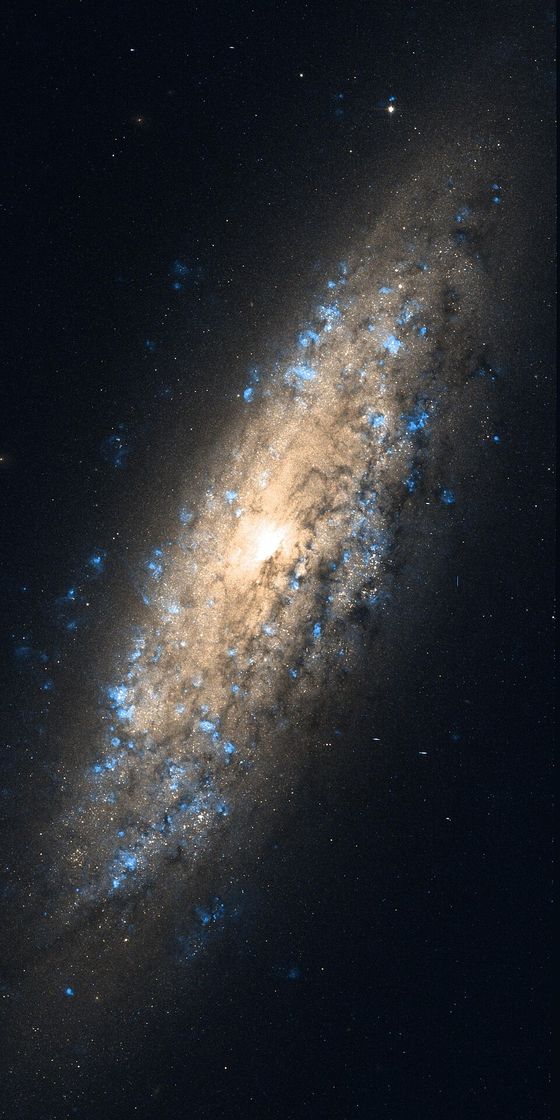
Weigh a spiral galaxy by its light — all those stars and gas clouds — and Newton makes a firm prediction about how fast its outer edge should turn. Most of the visible mass sits in the middle, so past it the orbital speed should fall off, the way Neptune crawls while Mercury races. In the 1970s Vera Rubin measured it and found the opposite: the outer stars move just as fast as the inner ones. The curve doesn’t fall. It goes flat — and fifty years later we still don’t agree on why.
Where we land: held open. The flat curve is settled fact; its cause is not — invisible mass and modified gravity fit the same line. A discrepancy is not yet a cause.
Fifty years on, two rival stories still fit that flat line equally well: invisible mass, or different gravity. On this data alone, you cannot tell them apart — and that stalemate is the story.
1 · The prediction, and the gap
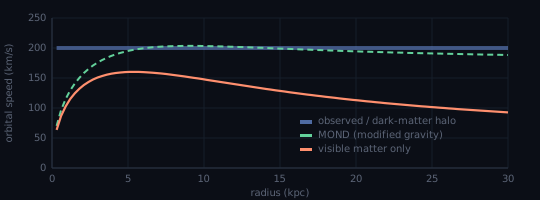
Below is a model galaxy — a standard exponential disk, one whose starlight thins out steadily from the centre — computed with our own code. The orange line is what its visible matter alone should produce under plain Newtonian gravity: a rise through the disk, then a long decline, the way planet speeds fall off with distance from the Sun. The thick faint line is what telescopes actually see — a flat curve, holding near 200 km/s all the way out. At 25 kpc (kiloparsecs — the yardstick astronomers use for galaxy distances) the visible matter predicts only 101 km/s, so the galaxy is spinning as if it held 3.9× as much mass as we can see.
2 · Two ways to close it — and neither loses
There are two honest ways to bend the orange line up onto the flat one, and the graph shows both landing in the same place. Add mass: wrap the galaxy in an invisible dark-matter halo whose bulk keeps growing with radius — tune it, and the total curve flattens (the blue line is the visible stuff plus such a halo). Or change the law: MOND — Modified Newtonian Dynamics — proposes that below a tiny threshold acceleration, gravity fades more gently than Newton’s inverse-square rule. Feed the same visible matter through that rule (green, dashed) and the curve flattens too, with no dark matter at all.
On this plot the green and blue lines all but coincide. That’s not a drawing choice — it’s the problem. Galaxy rotation curves, on their own, cannot tell the two apart. One says the light is lying about the mass; the other says Newton is lying about the force. The same flat line is the evidence for both.
The rotation curve is a fact. “Dark matter” and “modified gravity” are two different stories about the same fact — and the curve you’d draw to test one is the curve you’d draw to test the other.
3 · Where the tie breaks — and where it doesn’t
Beyond single galaxies the evidence does start to lean. Dark matter carries the larger scales convincingly — the cosmic microwave background, galaxy clusters, the Bullet Cluster’s neatly separated mass and gas, the whole growth of cosmic structure — where plain MOND struggles. But MOND still captures galaxy-scale regularities (the tightness of the radial-acceleration relation — how closely a galaxy’s actual pull tracks its visible matter) uncomfortably well for a mere coincidence, and dark matter’s particle has gone undetected through decades of ever-more-sensitive searches. So the leading answer is “dark matter,” and it is genuinely leading — but what actually generates the missing gravity is still open: one of the largest unresolved questions in physics.
Where this lands
The flat rotation curve is settled fact. Its cause is not. Dark matter leads — on scales larger than galaxies it wins — but its particle remains undetected, and modified-gravity models still fit galaxy rotation curves too well to dismiss. So we hold the split honestly: the measurement (the curve) is certain; the interpretation (unseen mass vs new physics) is not decided by this data, and only partly decided by the rest. A discrepancy is not yet a cause. We report the flat line as fact and its cause as the open frontier it still is — the good kind of mystery, and the biggest one in this series.
Why our math sees more
It’s tempting to say “rotation curves prove dark matter.” They don’t — they prove a discrepancy, and a discrepancy is not yet a cause. We keep the measured curve as the fixed point and treat both dark matter and modified gravity as candidate stories, to be judged on all the evidence — not just this graph, where they happen to tie. Knowing precisely which data breaks the tie, and which doesn’t, is the difference between a slogan and a result.
Sources
phenomenon — flat rotation curves: Rubin & Ford (1970); Bosma (1978); Rubin, Ford & Thonnard (1980). MOND: Milgrom, ApJ 270 (1983). Radial-acceleration relation: McGaugh, Lelli & Schombert (2016). Bullet Cluster: Clowe et al. (2006).
overviews — Galaxy rotation curve · MOND (Wikipedia) (third-party — linked, not re-hosted)
computed here — exponential-disk enclosed mass M(<r) = M[1 − (1+r/R_d)e^(−r/R_d)]; v_bar = √(GM/r); MOND simple-μ g = g_N(½ + √(¼ + a₀/g_N)); dark-halo curve = baryons + the mass needed to reach 200 km/s. M = 6×10¹⁰ M☉, R_d = 3 kpc, a₀ = 1.2×10⁻¹⁰ m/s². Own-code, stdlib math only (spherical-enclosed-mass approximation for the disk).