Dark Math · Release 012
Five Sigma of Daylight.
Two rigorous rulers measure how fast the universe expands — the early-universe glow and the local distance ladder — and their answers disagree so hard their error bars don't touch. Our own-code statistics put the gap at five sigma: about one in 1.8 million to be luck. Something real is going on — a hidden systematic or new physics — and nobody on Earth knows which yet. We print the gap at its true width and enjoy the view.
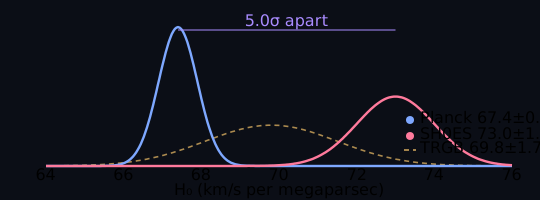
Ask the universe how fast it is expanding and you get two answers. One comes from the infant cosmos — the microwave afterglow of the Big Bang, read through our best model of physics — and says 67.4. The other comes from the nearby, present-day universe — a ladder of stars and exploding suns whose distances we measure almost directly — and says 73.0. Each comes with a small error bar. They do not overlap. Both camps have checked their work for a decade, and the gap has only gotten harder to explain away.
Where we land: held open. The five-sigma gap is real and settled; its cause — a hidden measurement bias or new physics — is not. Reported at its true width.
1 · Two rulers, two numbers
The Hubble constant H₀ is the universe’s expansion rate — kilometres per second of recession for every megaparsec of distance (the unit astronomers use for the gaps between galaxies). The early-universe value (Planck, reading the cosmic microwave background) and the late-universe value (SH0ES, climbing a distance ladder of Cepheid stars and supernovae) are measured in completely different ways, with completely different possible mistakes. That’s what makes their disagreement so serious: there’s no shared error to blame. Plotted as probability curves, they sit in different places on the axis, with clear air between them:
2 · It is not a coincidence
Could two honest measurements land this far apart by pure chance? Combine their error bars and the separation is 5.0 standard deviations — five sigma, in physics shorthand, where sigma measures the odds of being a fluke. The probability of a fluke that large is about 5.5×10⁻⁷ — roughly 1 in 1,825,729. Five sigma also happens to be the exact bar physics sets for claiming a discovery. By that same standard, the disagreement is a discovery: something real is going on. The two numbers are not both allowed to be right about a single universe with a single expansion rate — unless a hidden ingredient is missing.
When two careful rulers disagree by five sigma, one of them is wrong — or the thing you assumed they were both measuring isn’t what you thought it was.
3 · Two kinds of answer, neither in hand
The resolution has to take one of two shapes, and after years of work neither has arrived. A systematic error: a subtle bias nobody has caught — in the Cepheid distance ladder, or in how the microwave background is modelled. If so, the crisis dissolves into a mistake, and the standard model of cosmology survives untouched. Or new physics: both measurements are right, and the bridge between the infant universe and today — the standard cosmological model itself — is missing something: early dark energy, a new relativistic particle, evolving dark energy, a tweak to gravity. Both are live; nothing here picks between them.
Tellingly, the ladder has survived its hardest test: JWST re-checked the Cepheid distances and confirmed them (Riess et al.), closing that escape hatch on the Cepheid side. The tension didn’t break — though independent JWST programs (Freedman’s CCHP, using the tip of the red-giant branch, TRGB, as a different rung) land nearer Planck, so JWST has not settled it either way.
Where this lands
Both measurements are rigorous and reproducible; the 5.0σ gap between them is real, not chance. What it means — an uncaught systematic error, or new physics beyond the standard model — is unresolved, and actively fought over in the current literature. Nothing here is hidden: the data is public, the methods are open, and the answer still isn’t in. We report the gap at its true width — five sigma of daylight between two views of the same sky — and mark its cause as one of the biggest open questions in physics today. The good kind of mystery.
Why our math sees more
A single headline number (“the universe expands at ~70”) hides the whole story — because the story is the disagreement. We treat each measurement as a solid result with an honest error bar, put a number on the tension between them (5σ, not a fluke), and refuse either to average the two into a false peace or to declare a winner without cause. The gap is the finding — and naming it precisely, rather than smoothing it over, is exactly the discipline this whole series is built on.
Sources
measurements — Planck 2018 (Planck Collab., A&A 641, 2020): H₀ = 67.4 ± 0.5. SH0ES: Riess et al., ApJL 934 (2022): 73.0 ± 1.0; JWST confirmation: Riess et al. (2023–24). TRGB: Freedman et al. (CCHP, 2019–21) ~69.8 ± 1.7.
overview — Hubble tension (Wikipedia) (third-party overview — linked, not re-hosted)
computed here — tension = ΔH₀ / √(σ₁² + σ₂²) = 5.6 / 1.12 = 5.01σ; P(chance) = 2(1 − Φ(5.01)) = 5.5×10⁻⁷ via math.erf; curves = normal densities. Own-code, stdlib math only.