Dark Math · Release 013
The Lens Turned.
Twelve releases point the lens at other people's mysteries. This one turns it on our own ideas — same rules, same blade. Two of our favourite readings don't survive their own tests (we show exactly where), one candidate mechanism lives on inside an honest factor window, and our best curve shape meets 2,696 real galaxy data points and loses. But the wreckage hands over one keeper: the onset of the dark is memoryless — the exponential survival law, sole survivor of a race that eliminates every alternative. Testing yourself is the most fun you can have being wrong.
For twelve releases we pointed honest math at other people’s mysteries. This is release thirteen, where the lens turns around: our own framework, run through the same tests we use on everyone else’s ideas. This is the fun part — and the part that keeps us honest. Two of our favourite ideas did not survive the process. And then the wreckage, read carefully, handed over something none of the twelve mysteries did: a structural fact about the dark that any theory must now carry. This post is the whole arc — the flip, the break, and the find.
Where we land: still open — the good kind. Two of our own readings failed our own tests and stay on the page; one structural find is left standing; we’re not calling anything beyond that. Map the dark, refuse the crown.
1 · The flip — and the first casualty
Our framework reads the dark not as a substance hiding behind the light but as the bond — the relation of observation itself. Pointed at the sky’s open cases, it lands hardest on Release 011’s rotation curves: the tight law connecting visible matter to observed pull is exactly what a bond requires, where substance dark matter has to call it a conspiracy. But the first thing the turned lens did was catch one of ours. The tempting reading of Release 012’s Hubble tension as our “collapse discards the clock” theorem turns out to be a pun — a dimensionless count is not a rate, and a live disagreement is not an erasure. It didn’t survive, we’re the ones who said so, and it stays on the page. That catch is the credential for everything below.
2 · The bridge, the loop, and the window
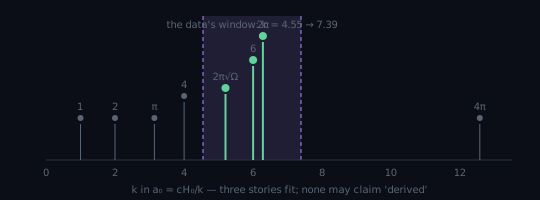
Two open cases meet at one number. The acceleration where the dark starts to ride, a₀ ≈ 1.2×10⁻¹⁰ m/s², is the cosmic horizon’s scale cH₀/2π to within ~10–15%. The coincidence is Milgrom’s (1983); our reading of it is the closure route: a bond is a round trip, and it fails to close when its stretch c²/a is longer than the loop around the horizon, 2πR — solve for the crossover and the 2π falls out of the geometry, not a curve fit. Then we did to our own route what we would do to anyone’s: put a number on it. Any story like this is really a claim about k in a₀ = cH₀/k, and the data allows a window of k that still fits three rival stories, ours among them. While more than one fits, nobody gets to say “derived” — us included.
The one serious rival stance is QBism, for which a quantum state is one agent’s private betting book. We gave it the strongest hearing we could — built its special measurement (the d=2 SIC, a perfectly even set of quantum questions) from raw arithmetic with our own code, and checked its rewrite of the Born rule — the rule that turns quantum states into betting odds — down to the last digit the machine can hold. Both halves stand. Then the gentle push: the rule QBism keeps is a public norm living inside a private-worlds philosophy, and it rests on a piece of geometry nobody has managed to prove since 1999. Both sides owe the same debt — the between: how two observers share one seam. Our note in the margin: in a universe like ours every observer’s horizon is their own, yet every horizon has the same radius. Private horizon, shared width — the between may have a shared scale, not a shared place.
3 · The stretch — and the break
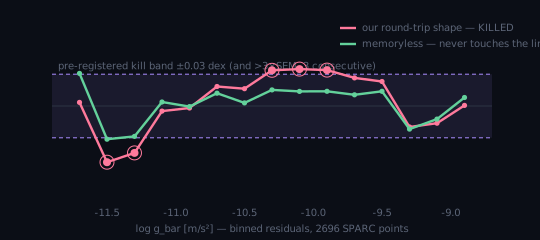
One honest move remained. House rule: one number can be storied; two must be structure. The closure mechanism only earns a rung if it also produces the shape of the missing-gravity curve — and the round trip picks its shape with no freedom left: the geometric mean, g_obs = √(g_bar(g_bar+a₀)). So we pulled the real SPARC archive (175 galaxies — the very data the law was discovered in), rebuilt the entire pipeline with our own code, and required it to reproduce the published science before testing anything (it did: 2696 points vs 2,693; a₀ 1.16 vs 1.20; scatter 0.133 dex — astronomy’s logarithmic unit). Then, before the residuals ran, we wrote down in advance exactly what result would change our mind. The shape didn’t survive. Three consecutive bins at the curve’s knee crossed the line we had drawn — and on the way down, its best fit abandoned the very 2π it came from.
4 · The turn — the onset has no memory
House rule number two: when we can’t see, we turn. The wreck’s residuals form a coherent S — the real curve hugs Newton longer, then lifts harder than any blend of the two. Follow that one level down, and the curve that survives everything factorises exactly as g_obs = g_bar / P, where P = 1−e−GM/a₀ and GM = √(g_bar·a₀). Read the pieces. P is a threshold probability — the chance that something clears a bar. Its argument is the geometric mean — the very shape that just failed, alive one level down as the question the threshold is asked about. And the law is the exponential one — the unique memoryless law, where the chance of the thing happening next never depends on how long it has already waited. So we raced six candidate threshold laws through the same test: too sharp, too soft, wrong tail, wrong placement — five failed; the memoryless one never grazed the line. (Of the three predictions we had written down in advance, two came in; the third half-missed, and that is on the record too.)
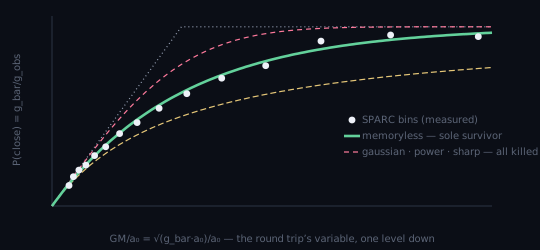
The missing-gravity curve is not shaped like a force. It is shaped like the probability that something closes — and the something has no memory.
Where this lands
The lens turned on its makers and behaved exactly as advertised. Down, by our own hand, twice: the Hubble-clock reading (a pun) and the round-trip shape (it failed on 2,696 real points, against a line we drew before looking). Still standing, ours: the closure mechanism for a₀ — honestly fenced by a window that fits three stories — and private horizon, shared width. Found, and it belongs to the data: the onset of the dark is memoryless, in the geometric-mean variable, in the divide placement — a triple any theory of the dark must now carry, selected by a race that eliminated every alternative. Deriving that triple from bond structure is parked for a cold session — a promise to try, not a promise it works. No god number. A god hold — and the hold held.
Why our math sees more
Because a test that can catch you is a test you can trust. This arc caught our best story, put an honest fence around our second-best, gave the rival its strongest day before pushing on it, and read the wreckage instead of burying it — and the wreckage pointed one level down to a fact the field can test with or without us. See, turn, learn: run the loop honestly enough and the lens stops being a tool you hold and becomes the structure you stand on.
Sources
data — SPARC: Lelli, McGaugh & Schombert 2016, AJ 152, 157. The RAR + fit: McGaugh, Lelli & Schombert 2016, PRL 117, 201101. a₀~cH₀: Milgrom 1983–. QBism: Fuchs, Mermin & Schack 2014; SIC existence: Zauner 1999 (open).
computed here — factor window k ∈ [4.55,7.39]; d=2 SIC + urgleichung exact (companion notes); SPARC pipeline 2696 pts validated 3/3; round-trip shape out (rms 0.1346; three knee bins past the line); memoryless survivor (rms 0.1327; never crossed the line). Own-code, stdlib math only.
the record — lab notes lens-pass-02/03/04.md + lens_pass_02/03/04.py; full detail folders lens-turned/ · shape-of-the-knee/ (SPARC cache) · onset-no-memory/.