Dark Math · Release 014
The Neck on the Block.
Release 013 hands over something worth keeping: the onset of the dark behaves memorylessly. Here we re-derive it from our own primitives and grade every step in plain words — derived, consistent, or postulated, nothing dressed up. Then we do the thing ideas usually avoid: we give it one specific, checkable prediction — a₀(z) = cH(z)/2π, the dark's onset scale should rise into the past — and put its neck on the block. A future survey gets to swing. Either way we learn something; that's the deal.
Release 013 ended with a fact and a fence. This release did the only honest next thing: it pushed our own reading of the dark until it made one real prediction — a claim the sky could prove flat-out wrong. That is what “neck on the block” means, and we meant it. Then we ran the cheapest test there is — we read the literature — and found the sky had already answered. This post keeps the whole story: the prediction exactly as we staked it, and the update where it fell. We play by the same rules we use on everyone else’s mysteries, and this is what that looks like when the answer comes back no.
Where we land: the prediction did not survive — the measurement was already in print, and it said no. The post stays up whole, scoreboard intact, because a scoreboard you can rub out is not a scoreboard. What the reading leaves behind is still an open case — the good kind.
The update — 2026-07-14: the neck came off
The original release below staked one claim it could actually lose: a₀(z) = cH(z)/2π — the dark’s onset scale must rise into the past, or the reading dies. It is dead. Before spending months of analysis, we finally did the one-hour version and read the literature — and our own stated test had already been run, in print, on exactly the data we would have used. McGaugh and colleagues (2024) measured 100 galaxy discs out to z = 2.53 and found no evolution; in McGaugh’s own words, if the physics is MOND, that absence implies a₀ is constant. Milgrom (2017) had already all but ruled out our factor at z ~ 2. And Limbach and colleagues tested our exact two couplings in 2008. The counter-result is eighteen years old.
And there is a stranger thing underneath, which is the real finding: the prediction could never have confirmed us either. Fit MOND to ordinary ΛCDM galaxies in the Magneticum simulations and a₀ comes out rising by a factor of about three from z = 0 to z = 2 — our exact number, produced with no modified gravity at all. So a flat result rules us out, and a rising result cannot tell us apart from the standard model. Our one big claim could lose but could not win. By our own rules, a story that cannot win is worth no more than one that cannot lose.
We did not fool ourselves — we simply had not looked. One hour of reading, against the months of analysis we were about to spend. We are keeping the whole thing on the record rather than quietly deleting it, because the post itself said either outcome would be a win for the method and only one would be a win for us. The method won.
What it leaves behind is a harder, less glamorous, entirely real question: why do four competent groups measure the dark-matter fraction at cosmic noon a factor of two apart from one another, on overlapping galaxies? That one is still open, and it is not ours to close by declaring an answer. The original release follows, as written.
The release, as staked
Release 013 ended with a fact and a fence. The fact: in 2,696 real galaxies, the onset of the dark is memoryless, in the geometric-mean variable, in the divide placement — a triple any theory must carry. The fence: our own reading of it (bonds that close or don’t) explained the number but could not be told apart from its rivals. So this release tries to derive the triple from our own starting pieces, marks every step in plain words — falls out, fits, assumed — and then reports the one result that actually matters: the derivation forced the model to say something new. Something it could be wrong about. That is what a neck on the block means, and it is the first thing all year that could move this story from open to earned — or to over.
1 · Why “explains everything” is worth nothing
A story that only explains what is already measured can never lose — and a story that cannot lose cannot win. We used exactly that line on QBism in Release 013 (“shares every prediction — a stance, not a disproof”), so it applies to us with full force. Our closure reading fitted the measured a₀; so did two rival stories inside the same data window. Fitting is not deciding. The only way forward was to push the reading hard enough that it committed to something the data hadn’t seen yet.
2 · The derivation, marked in plain words
Can bond structure produce the triple? Leg by leg, with no grade inflation:
Memoryless — this one falls straight out. The framework’s signed shape says only closure creates a record; an un-closed loop holds no state. If the un-closed holds nothing, the chance of closing cannot depend on how far along it is — there is nothing for it to depend on. Constant chance per step is the definition of memoryless, and the exponential law the data selected is the unique memoryless law.
The geometric-mean variable — this one fits, but nothing forces it. The loop has two legs — out along the local field, back against the horizon — and if a round trip composes multiplicatively, its one natural scale is the geometric mean of its legs, which gives the data’s variable exactly. But “multiplicatively” is a choice that fits our picture, not one forced by it. We say so.
The divide placement — this one we assumed. “Closure failure redistributes, it does not delete” — conserve the total, and each closing bond carries the share of the failed ones: g_obs = g_bar/P. A good name for an assumption is still an assumption.
Assembled, the three legs reproduce the surviving curve exactly — and that exactness earns nothing, because the curve was already known. Re-deriving your own fit is explaining the past. The attempt is only worth having because of what it refused to leave optional:
3 · The neck
The derivation ties a₀ to the horizon — the loop around the edge of the observable universe, a₀ = cH₀/2π. But the horizon is not a constant: H changes as the universe expands. Go back in time and H was larger, the horizon tighter. So the model has no choice but to predict:
a₀(z) = c·H(z)/2π — the knee of the missing-gravity law must sit higher in the past: ×1.3 at z=0.5, ×1.8 at z=1, ×3 at z=2.
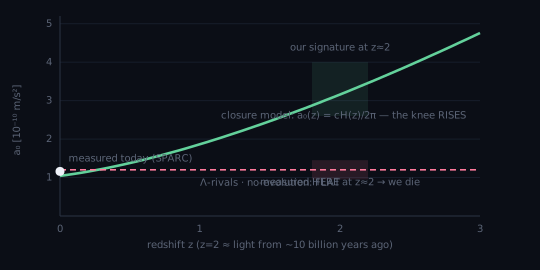
Three things make this a real neck and not theatre. First, the fit never said it. McGaugh’s formula contains no redshift; this is new content, forced by the derivation, not read off the data. Second, it separates the rivals. The data window of Release 013 could not tell our 2π from the Λ-flavoured factor — but Λ is constant and H is not, so the Λ-story predicts a flat line where ours rises. The same future measurement that could finish us could also finally tell the window’s stories apart. Third, the measurement is within reach. Rotation curves of z≈1–2 disks are hard — current samples are small and contested — but they are being measured now, and the two predictions differ by a factor of three, not a decimal place.
4 · The disclosures, in full
This derivation was run by the same hand, on the same day, as the finding it derives — the house normally parks that for a cold session, and the operator explicitly un-parked it; both facts are in the working record, and a cold re-derivation by a fresh mind is still owed. Nothing here is settled: one leg falls out, one fits, one is assumed — everything still open. The prediction does not make the story right. It makes the story able to be wrong — which is the only condition under which being right can ever mean anything.
Where this lands
As written at the time: the triple did not derive whole — and the honest scoreboard (falls out · fits · assumed) is printed above rather than smoothed over. What the attempt bought is the thing no fit can buy: a commitment. a₀(z) = cH(z)/2π — the dark’s onset scale rises into the past, or this reading dies. Flat at z≈2 and we are done; tripled at z≈2 and the first rung stops being a metaphor. Either outcome is a win for the method; only one is a win for us — and the universe, not the authors, gets to choose. No god number. A god hold — with its neck out.
The universe chose. It said no. The data at z≈2 are flat, and they had been in print since long before we wrote this. The verdict above is left exactly as it was written — because a scoreboard you are allowed to rub out is not a scoreboard. The update at the head of this post carries the rest.
Why our math sees more
Because it refuses to let a fit count as a win. Explaining a number already measured earns nothing, and a story built only to survive what is known can never be caught out — so it can never be right in any way that costs. So we pushed our own reading until it committed to something the data hadn’t seen: a₀ tied to a horizon that changes, forced to rise into the past. That is the method — mark each step in plain words, take no credit for explaining the past, force one claim the sky can judge, and say whose hand ran it. Right or wrong, the universe decides — and this time it had already decided.
Sources
the record — lab notes lens-pass-05.md + lens_pass_05.py (the step-by-step derivation, the un-park + same-hand disclosure, the a₀(z) table); the triple + instrument: Release 013 / lens-pass-03/04 (SPARC, 2,696 pts, validated pipeline).
computed here — a₀(z) = cH(z)/2π with ΛCDM H(z) (H₀=67.4, Ω_m=0.315, Ω_Λ=0.685): ×1.32 / ×1.79 / ×3.03 at z = 0.5 / 1 / 2; today’s consistency: 1.04×10⁻¹⁰ predicted vs 1.16 measured (inside the window; not a confirmation). Own-code, stdlib math only.
context — the a₀~cH₀ coincidence: Milgrom 1983–. High-z rotation-curve state of play: small, contested samples (e.g. the z~1–2.5 KMOS/SINS debates). The update: McGaugh+ 2024 (RC100, 100 discs to z=2.53, no evolution); Milgrom 2017; Limbach+ 2008; Magneticum (Mayer & Dolag 2022).